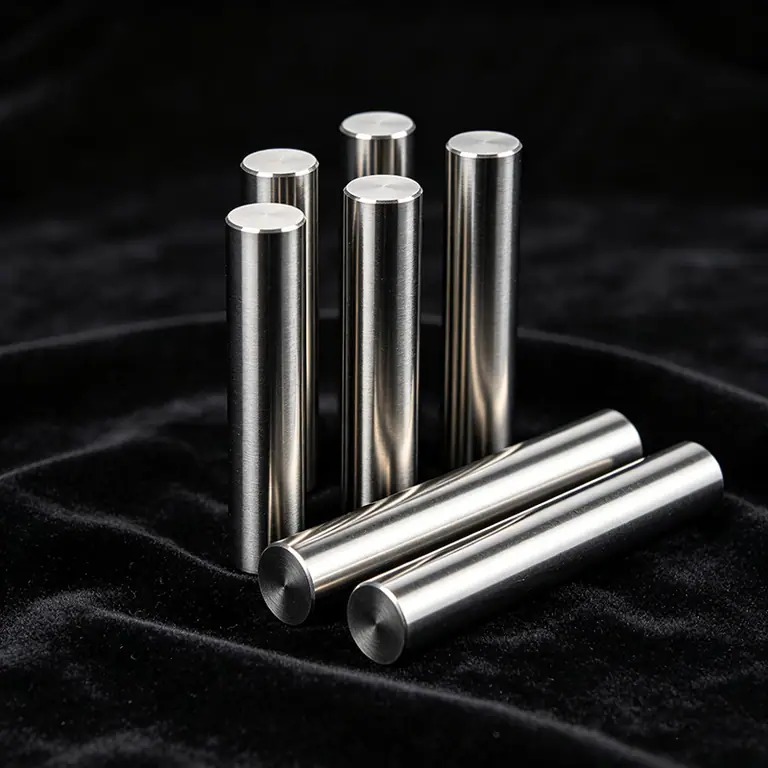
PM23 is made by gas atomising molten steel into powder and consolidating it — no casting, no ingot, no macrosegregation. The result is a steel with a uniform structure that conventional melting cannot produce, and it changes failure behaviour, not just headline hardness.
Engineers often ask the same question: if W6Mo5Cr4V2 and PM23 both finish at around HRC 64, why pay several times more for PM23? The answer is that hardness is not the property doing the work. Carbide size, carbide distribution and the resulting toughness at high hardness are.
GB standard reference
- Standard
- GB/T 1299 (alloy tool steel) · GB/T 1220 (stainless)
- GB grades in this article
- PM23 · W6Mo5Cr4V2
- Also sold as
- ASP23 is a trade name; PM M3:2 by alloy class · M2 / SKH51
- Hardness range
- HRC 64-65 (PM23) · HRC 60-63 (W6Mo5Cr4V2)
1. Why Powder Metallurgy Steel Is Different
In a conventionally cast high-speed steel, the carbides form during slow solidification and grow into coarse, often banded structures. Those coarse carbides are extremely hard, which is good for wear, but they are also brittle and they act as stress concentrators. Under a cutting load, micro-cracks initiate at the carbide-matrix interface.
- 1Melt — the alloy is brought to full solution like any high-speed steel
- 2Atomise — a high-pressure gas jet breaks the melt into fine droplets that solidify in milliseconds
- 3Consolidate — the powder is sealed in a capsule and hot isostatically pressed to full density
- 4Forge and roll — the fully dense billet is worked down to bar
Because each powder particle solidifies almost instantly, carbides cannot grow beyond a few microns, and there is no ingot-scale segregation. The resulting bar has essentially identical properties at the centre and at the surface.
| Characteristic | W6Mo5Cr4V2 (conventional) | PM23 (powder metallurgy) |
|---|---|---|
| Typical carbide size | 5-20 µm, banded | ≤ 3 µm, uniform |
| Segregation | Present | Effectively none |
| Core-to-surface consistency | Varies with bar diameter | Consistent |
| Toughness at equal hardness | Baseline | Significantly higher |
| Grindability at HRC 64-66 | Difficult | Better, more predictable |
| Relative material cost | Baseline | 4-6× |
2. Performance in a Rotary Die
The practical difference shows up in three places: micro-chipping resistance, edge retention at temperature, and dimensional stability after heat treatment.
2.1 Micro-chipping resistance
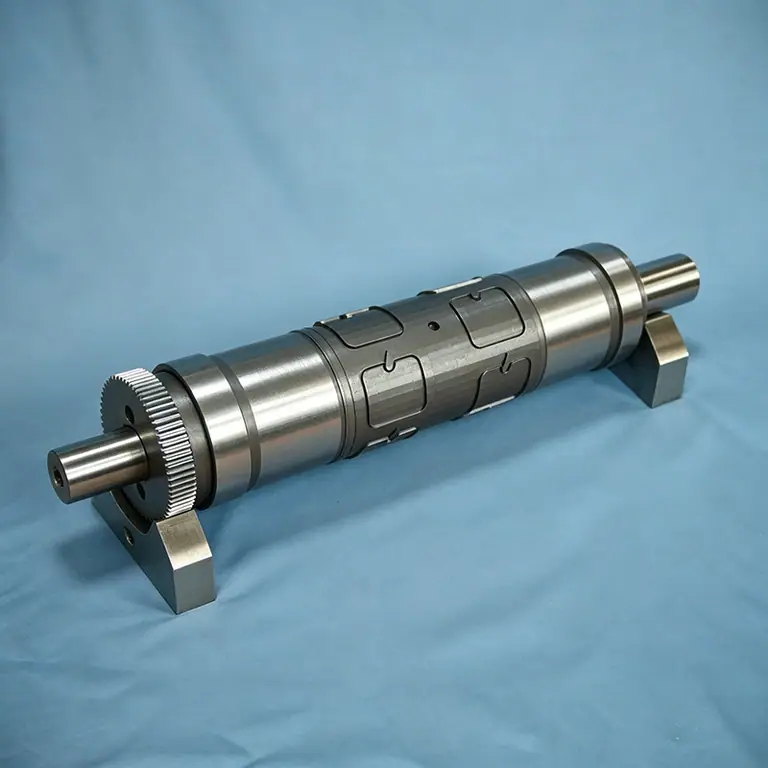
This is where PM23 earns its price. A die that micro-chips in W2Mo9Cr4VCo8 is usually failing at a coarse carbide. Remove the coarse carbides and the initiation sites disappear, so the edge wears progressively instead of breaking down. A progressively wearing edge can be re-sharpened on a predictable schedule; a chipping edge fails unpredictably.
2.2 Edge retention at temperature
PM23 is not a cobalt grade — its red hardness comes from a high vanadium and tungsten content combined with the uniform structure. In practice PM23 holds HRC 64-65 in service comparably to W2Mo9Cr4VCo8, and in some film-slitting applications it outlasts W2Mo9Cr4VCo8 because it does not chip first.
2.3 Dimensional stability
Uniform carbide distribution means uniform response to quenching and tempering. On long rotary die bodies, the runout after heat treatment is measurably lower than with conventional grades, which reduces grinding stock and the risk of ending up under size.
3. The Cost Calculation, Done Properly
Compare two identical film-slitting rotary dies, one in W2Mo9Cr4VCo8 and one in PM23. Assume the W2Mo9Cr4VCo8 die costs 100 and lasts 6 weeks between re-sharpens; the PM23 die costs 250 and lasts 14 weeks. If a re-sharpen costs 25 in labour and lost production, the W2Mo9Cr4VCo8 die costs 100 + (4 × 25) = 200 over 24 weeks, while PM23 costs 250 + (1 × 25) = 275. PM23 is still more expensive in that scenario — until you add the cost of one unplanned stoppage, which typically exceeds the whole difference.
PM23 is justified when unplanned downtime is expensive and failure is unpredictable. It is not justified when the die is easy to reach, quick to change and fails on a predictable wear schedule.
| Situation | Conventional HSS is fine | Powder metallurgy pays off |
|---|---|---|
| Failure mode | Gradual edge wear | Micro-chipping at coarse carbides |
| Machine access | Easy, fast changeover | Difficult, long changeover |
| Material cut | Paper, carton, soft film | Abrasive or metallised film, thick board |
| Production pattern | Short runs, frequent grade changes | Continuous long runs |
| Die geometry | Simple, robust tooth profile | Fine pitch, thin tooth roots |
Powder metallurgy steel: frequently asked questions
PM23 is a Chinese designation that corresponds to the same grade family as PM23. Both are powder metallurgy high-speed steels in the M3:2 class. When specifying, state the required hardness range and application rather than relying on a single trade name.
Nanfoss supplies PM23 round bar and machines powder metallurgy steel rotary dies to drawing. Send us the failure photos from your current die and our engineers will tell you honestly whether a grade change will help.