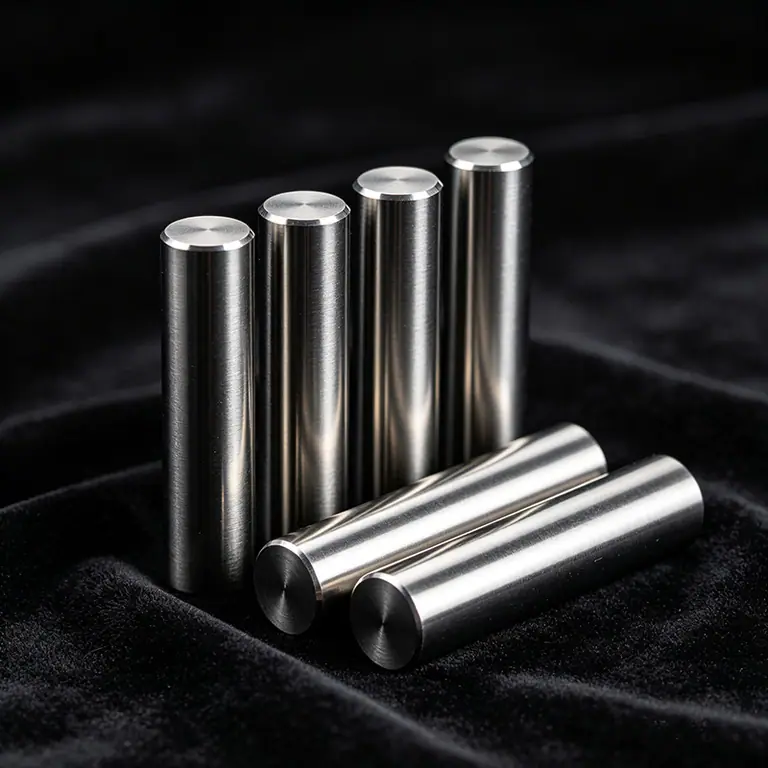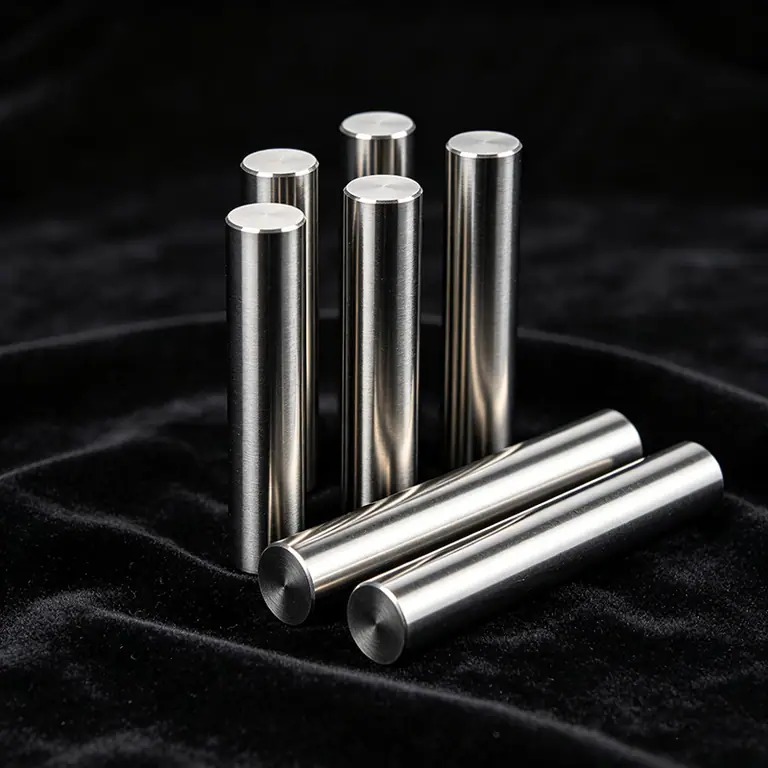
Cr8Mo2SiV is the grade most die shops reach for when Cr12Mo1V1 starts chipping. It keeps the high hardness of a 8% chromium cold-work steel but adds enough toughness to survive impact loading — provided it is heat treated correctly.
In die making, material choice directly determines tool life, precision and cost. Developed by Daido Steel of Japan, Cr8Mo2SiV is a cold-work tool steel that has drawn wide attention since its launch. It is widely regarded as the upgraded successor to Cr12Mo1V1 — yet many engineers still misunderstand how it behaves in practice.
Drawing on years of hands-on experience machining Cr8Mo2SiV round bar, this guide walks through Cr8Mo2SiV selection in four dimensions: chemistry, heat treatment, real machining numbers and typical applications.
- Standard
- GB Cr8Mo2SiV · JIS SKD11 modified · AISI D2 mod
- Typical delivery hardness
- HRC 58-62 (annealed HB 210-230)
- Hardness uniformity we hold
- ±1 HRC along the bar
- Decarburization layer
- ≤ 0.05 mm
- Stock diameters
- Φ2 - Φ100 mm, ground
GB standard reference
- Standard
- GB/T 1299 (alloy tool steel) · GB/T 1220 (stainless)
- GB grades in this article
- Cr8Mo2SiV
- Also sold as
- DC53 · JIS SKD11 modified · AISI D2 mod · DIN 1.2379 mod
- Hardness range
- HRC 60-62
1. What Makes Cr8Mo2SiV Different
Cr8Mo2SiV is a chemically refined version of Cr12Mo1V1: carbon and chromium are slightly reduced, while molybdenum and vanadium are added. The result is substantially higher toughness while retaining high hardness.
| Element | Cr12Mo1V1 | Cr8Mo2SiV | Effect of the change |
|---|---|---|---|
| C (Carbon) | 1.40-1.60% | 1.00-1.05% | Fewer coarse carbides — better toughness |
| Cr (Chromium) | 11.0-13.0% | 7.80-8.50% | Finer, more evenly distributed carbides |
| Mo (Molybdenum) | 0.80-1.20% | 1.80-2.10% | Stronger secondary hardening response |
| V (Vanadium) | 0.20-0.50% | 0.80-1.20% | Harder MC carbides — better wear resistance |
1.1 Balancing hardness and toughness
After vacuum heat treatment, Cr8Mo2SiV reaches HRC 60-62, on par with Cr12Mo1V1. Its real advantage is toughness: at the same hardness, Cr8Mo2SiV's Charpy impact toughness is roughly 30% higher than Cr12Mo1V1. In stamping and die-cutting applications that see impact loads, Cr8Mo2SiV dies are far less prone to chipping and cracking.
At HRC 61, Cr8Mo2SiV delivers a Charpy impact value above 35 J/cm², versus roughly 25 J/cm² for Cr12Mo1V1 at the same hardness.
1.2 Machinability
Cr8Mo2SiV's annealed hardness is around HB 210-230 — slightly lower than Cr12Mo1V1 — which makes it noticeably easier to machine. This is a real benefit for wire-EDM and milling of complex die profiles: lower tool wear and faster cycle times.
- Lower annealed hardness means lower cutting forces and roughly 20% longer tool life
- Better surface quality after wire-EDM, with a thinner recast layer
- Excellent grinding and polishing behavior for high-precision cutting edges
- Good dimensional stability with minimal distortion after heat treatment
2. Vacuum Heat Treatment — Key Parameters
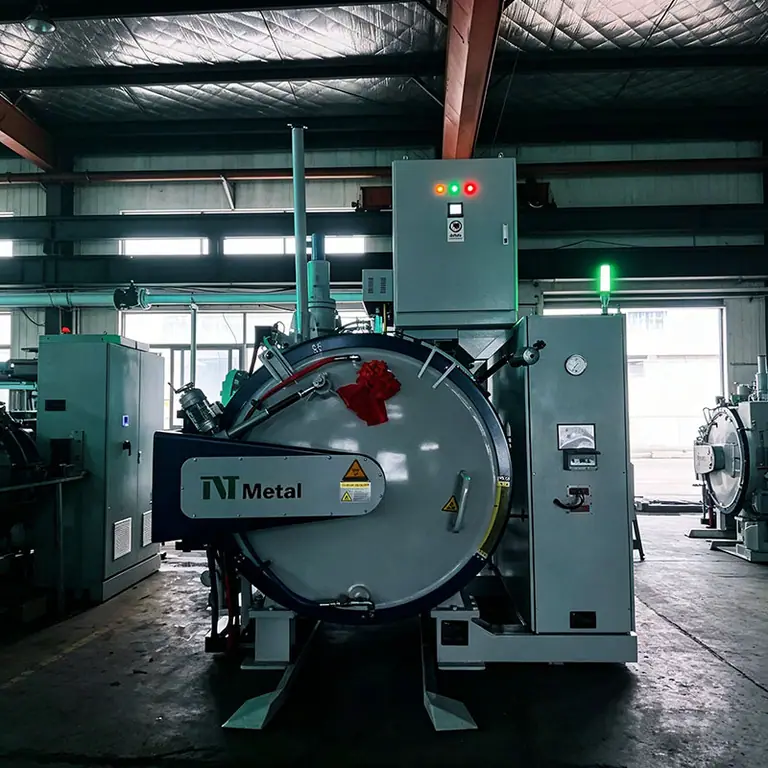
Cr8Mo2SiV has a wider heat-treatment window than Cr12Mo1V1, but getting the best out of it still requires tight control of the critical parameters. Below is the recommended cycle based on our production experience.
| Stage | Temperature (°C) | Hold Time | Cooling | Resulting Hardness |
|---|---|---|---|---|
| Preheat | 500-550 | 30 min | — | — |
| Second preheat | 800-850 | 20 min | — | — |
| Austenitizing | 1020-1040 | 20-25 min | Gas quench (N₂) | HRC 63-65 |
| First temper | 180-200 | 120 min | Air cool | HRC 60-62 |
| Second temper | 180-200 | 120 min | Air cool | HRC 60-61 |
Cr8Mo2SiV must be tempered twice to fully relieve quenching stresses. With only a single temper, cracking during wire-EDM is very likely — and an entire bar can be scrapped.
2.1 Why the second temper matters
During quenching, part of the austenite does not transform and stays retained at room temperature. A single temper relieves stress but leaves that retained austenite in place. It transforms later — sometimes during wire-EDM, sometimes in service — and the accompanying volume change is what cracks dies. The second temper completes the transformation before the part ever reaches your machine.
2.2 Controlling hardness uniformity
For die-grade round bar, hardness uniformity along the full length is a critical indicator. Our combined process — vacuum gas quenching, deep cryogenic treatment and double tempering — holds hardness variation within ±1 HRC over the whole bar, with measured values matching at the head, middle and tail.
3. Typical Applications
Thanks to its balance of hardness and toughness, Cr8Mo2SiV excels across a wide range of die applications. Three typical cases:
- 1High-precision die-cutting rules (thin stock, 0.5-2 mm): Cr8Mo2SiV's high hardness and wear resistance keep edges sharp longer, while its toughness prevents thin edges from chipping
- 2Progressive-die punches (medium plate, 2-4 mm): under repeated impact loads, Cr8Mo2SiV's high toughness significantly extends die life
- 3Precision shear blades (thin sheet metal): where edge straightness and surface finish matter, Cr8Mo2SiV's grindability meets the requirement
4. Selection Summary
Putting it all together, Cr8Mo2SiV is the first choice for die work in the following situations:
| Application | Recommended Grade | Recommended Hardness | Value Rating |
|---|---|---|---|
| High-precision die-cutting rules (thin stock) | Cr8Mo2SiV | HRC 60-62 | ★★★★ |
| Standard hardware stamping dies | Cr12Mo1V1 | HRC 58-60 | ★★★★★ |
| Heavy-plate / heavy-load blanking | Cr12MoV | HRC 58-60 | ★★★★ |
| Progressive-die punches under impact | Cr8Mo2SiV | HRC 60-62 | ★★★★★ |
There is no single best grade — only the most suitable one. Cr8Mo2SiV's strength is its balanced overall performance: when your die needs both high hardness and impact resistance, it is the answer.
Cr8Mo2SiV: frequently asked questions
No. Cr8Mo2SiV wins wherever impact loading or thin cutting edges are involved, because it is roughly 30% tougher at the same hardness. For uncomplicated, medium-load stamping dies, Cr12Mo1V1 still delivers the best value and costs 20-30% less as raw material.
For Cr8Mo2SiV round bar specifications, pricing or a custom processing plan, contact our engineering team for one-on-one selection advice.